(01)
.jpg)
Studios
Digital Content Production Arm (Coming Soon)
(02)

North Star Sprint
Strategic Alignment Workshop
(03)

Cortex
AI Powered Intelligence Software
(Exclusive to Clients)
(Exclusive to Clients)
Close
There was a time when most companies operated quietly behind their brands. Consumers recognized the logo. They trusted the product. But they rarely knew much about the person leading the company.
That dynamic has changed.
Today, many founders and CEOs have become highly visible figures. Their ideas, opinions, and public decisions shape how people understand the company itself. In some cases, the connection between leader and brand becomes so strong that the two are almost inseparable.
This shift is not limited to Silicon Valley or technology companies. Across industries and markets, leadership is becoming a visible layer of brand identity, one that customers, employees, and investors increasingly pay attention to.
For companies thinking about how their brand is perceived, this raises an important question: how much of your brand is shaped by the people leading it?
Several forces contributed to this shift, and they have been building for more than a decade.
Social media gave founders direct access to audiences without needing a press release or a media interview. A CEO could share a perspective, respond to a customer, or comment on an industry trend in seconds, from their own account, in their own voice. LinkedIn users are three times more likely to engage with content that features a CEO or founder compared to standard brand content. Content shared by employees receives roughly twice the engagement of posts published by official company pages.
Customers also began showing greater interest in the people behind the businesses they support. As trust in institutions declined, people started looking for individual voices they could relate to. The 2026 Edelman Trust Barometer found that trust is increasingly concentrated among those closest to us, with 66 percent of people trusting their own CEO. In an era where seven in ten people report hesitance to trust those with different values or backgrounds, the personal credibility of a leader has become a more powerful asset than corporate messaging alone.
Leadership transparency became expected, not optional. Founders started sharing insights about product development, company culture, hiring decisions, and strategic direction. This gave companies a human dimension that logos and taglines alone could not provide.
The result is a shift that favors leaders who are willing to be visible, who have something meaningful to say, and who can connect their personal convictions to the direction of the company.
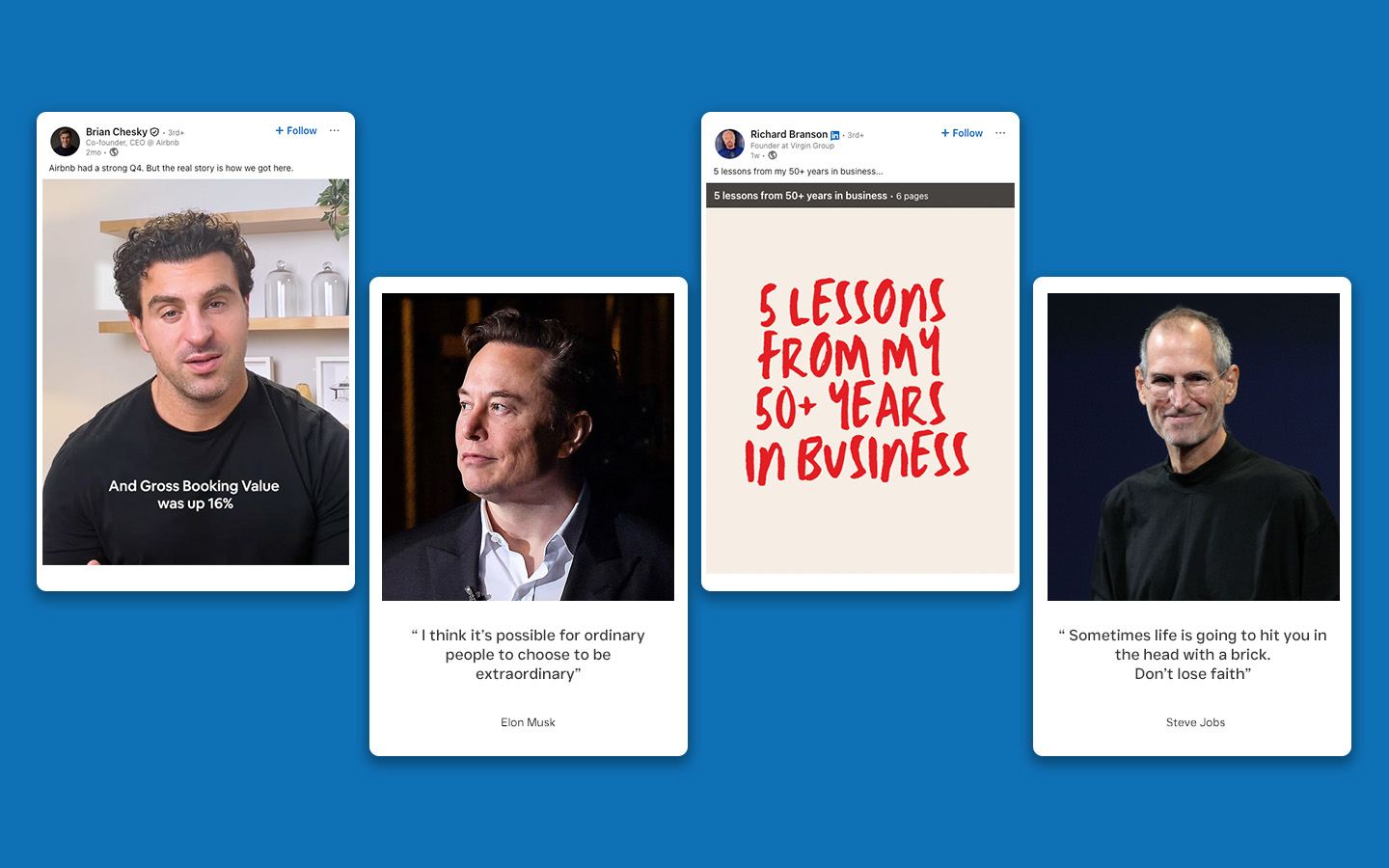
Some companies illustrate just how closely leadership and brand identity can become connected.
Steve Jobs and Apple. Jobs did not simply manage Apple. He shaped the philosophy behind the company's products and, in doing so, defined a brand that continues to carry his influence more than a decade after his passing. His emphasis on simplicity, design, and user experience was not a marketing strategy. It was a worldview. When he returned to Apple in 1997, he stripped the product line down to four core offerings and focused the entire company around a single idea: creativity drives growth. Under Tim Cook, Apple became the first company to reach a trillion dollar valuation. The principles Jobs established still guide the company. What makes this significant for branding is not just that Jobs was a strong leader. It is that he built a brand philosophy that could outlast him.
Elon Musk and Tesla. Tesla's brand has become closely tied to Musk's personality and ambitions. His public statements, technological vision, and willingness to challenge industry norms have contributed to Tesla's image as an unconventional innovator. Tesla has built enormous brand awareness with relatively little traditional advertising. Musk's personal following has functioned as a marketing channel on its own. But the Tesla example also illustrates the risks. When a brand becomes deeply identified with one person, that person's public behavior becomes part of the brand story, for better and for worse. Controversial statements and public disputes do not stay separate from the brand. They become the brand.
Richard Branson and Virgin. Branson built the Virgin brand with a sense of boldness and adventure that mirrored his own personality. What made him effective as a brand figure was consistency. His public personality matched the brand's values: energetic, unconventional, willing to take risks. The brand expanded across dozens of industries, from airlines to music to telecommunications. In each case, Branson's personal brand provided a unifying thread. People trusted Virgin in new categories partly because they trusted the person behind it.
Brian Chesky and Airbnb. Chesky now runs all major feature announcements through his personal social media accounts rather than through the company's official channels. The engagement on his personal posts consistently outperforms the company page. This reflects a broader trend where audiences respond more strongly to individual voices than to institutional ones.
When founders or CEOs play a visible role, their decisions inevitably influence how the brand evolves. Strategic priorities, product philosophy, company culture, and even the language the company uses all reflect leadership thinking.
Most companies treat branding as a design exercise or a marketing function. But the strongest brands are shaped by direction, by a clear understanding of where the company is going, what it believes, and why it exists. That direction almost always originates from leadership.
When leadership has clarity about the company's purpose and trajectory, the brand reflects it. The messaging becomes more consistent. The visual identity feels more intentional. Internal teams align more easily around shared priorities. When leadership lacks clarity, or when the brand is developed separately from the company's actual strategic direction, the result is a disconnect. The brand looks polished on the surface, but it does not hold up under scrutiny. Customers can sense it. Employees can feel it.
This is why the most effective branding work begins with leadership alignment. Before you design the logo or write the tagline, you need to know where the company is going. The brand should reflect that direction, not the other way around.
One reason founder led brands resonate is authenticity. Customers respond positively when leaders speak openly about challenges, decisions, and ambitions. The 2026 Edelman Trust Barometer highlights this: in a world where people are retreating into smaller, more familiar circles of trust, a CEO who communicates honestly about the company's direction can build a level of trust that no campaign can replicate.
But authenticity cannot be manufactured.
If a leader's public persona feels disconnected from how the company actually operates, the brand suffers. Employees notice when public statements do not match internal culture. Customers notice when the founder's personal brand says one thing and the product experience says another.
Authenticity in this context does not mean being casual or oversharing. It means alignment. The leader's public voice should reflect the company's actual values, priorities, and behavior. When there is alignment, the brand gains depth. When there is a gap, credibility erodes.
For companies considering a founder led brand strategy, the first question is not "how do we increase our founder's visibility?" It is "does our founder's public voice accurately reflect where the company is going and how it operates?"
Founder led branding carries real risks, and companies should approach it with clear thinking.
Leadership transitions create brand vulnerability. If the brand becomes too closely identified with one person, changes in leadership can create uncertainty. Customers, investors, and employees may struggle to connect with the brand once the founder steps away.
Public controversies affect brand perception directly. When a founder's personal behavior or public statements generate negative attention, the company absorbs the impact. This is not theoretical. Multiple high profile companies have experienced significant brand damage tied directly to the actions of their founders.
Over reliance on one voice limits organizational resilience. Companies with strong founder led brands sometimes struggle to develop other credible voices within the organization. This creates a fragile structure where the brand depends on one person's availability, judgment, and public reputation.
The most effective approach is to build a brand that is informed by leadership but not dependent on a single individual. The founder's thinking can shape the brand's direction. Their values can influence the culture. Their voice can help establish the company's position. But the brand itself, its identity, its values, and its strategic direction, must be sustainable beyond any one person.
Many founders today contribute to their company's brand by sharing ideas publicly through social media posts, articles, interviews, and speaking engagements.
This kind of thought leadership does more than build personal reputation. It positions the company as a thoughtful participant in its industry. When leaders articulate clear perspectives on the challenges facing their sector, the brand begins to represent more than just products or services. It becomes associated with ideas. In competitive markets where products can feel interchangeable, the company's point of view becomes a genuine differentiator.
LinkedIn data supports this. Thought leadership posts generate six times more engagement than job related content on the platform. C suite executive presence on LinkedIn has increased 35 percent in the past five years, with a 23 percent increase in their posting frequency. Leaders are not just present on these platforms. They are actively shaping conversations, and their companies benefit from it.
For companies that want to establish a stronger position in their category, developing the founder's or CEO's public voice is one of the most efficient strategies available. It does not require a large advertising budget. It requires clarity about what the company believes and a leader willing to communicate it consistently.
The tone set by leadership also influences how customers experience the brand in practice. Company culture, service standards, communication style, and even the speed at which the company responds to problems often reflect the values promoted by leaders.
This connection is often underestimated. Companies invest heavily in external brand communication, but the most powerful brand signals come from the actual experience customers have when they interact with the company. A strong visual identity can attract attention. But if the customer experience does not match the brand promise, the brand loses credibility over time.
Leadership is where that alignment begins. The decisions leaders make about how the company operates become the foundation of how the brand is actually experienced.
When founders actively participate in communicating the company's ideas, they help bridge two functions that many organizations struggle to connect: branding and marketing.
Branding defines what the company stands for. Marketing communicates that to specific audiences. In many companies, these two functions operate independently, which creates inconsistency. The brand says one thing. The marketing says something different. The customer gets confused.
Founders who are publicly active often serve as a natural bridge. Their perspective clarifies what the company believes, while their visibility reaches audiences directly. This combination is powerful because it eliminates the gap between long term brand identity and day to day marketing activity.
The 2026 Edelman Trust Barometer found that 73 percent of respondents believe the CEO is expected to lead efforts to bridge trust within and outside the organization. When leaders communicate clearly about the company's direction, internal teams gain a framework for making decisions that align with the brand. Marketing teams know what to say. Product teams know what to prioritize. Sales teams know how to position the company.
The result is not just better marketing. It is organizational alignment, the foundation of every strong brand.
Leadership visibility is becoming a meaningful component of brand identity. Companies that ignore it may find themselves at a disadvantage.
When founders share clear ideas about the direction of their business, the brand gains depth. Customers begin to associate the company with a mindset, not just a product. Employees align around a shared sense of purpose. Over time, that connection strengthens trust and influences how the brand is perceived in the market.
This does not mean every CEO needs to become a social media personality. It means companies should think deliberately about how leadership shapes the brand, and whether their brand accurately reflects the thinking behind the business.
Direction starts with leadership. And the brand should follow the direction, not the other way around.
If your company is thinking about its brand, start with a conversation about where the business is going.
What is a founder-led brand?
A founder-led brand is one where the founder or CEO's public presence, ideas, and personality become a visible layer of the company's identity. It's not just about posting on social media,. it's about how the leader's thinking shapes what the company stands for and how it communicates. When a founder has genuine clarity about where the business is going, that clarity comes through in the messaging, the culture, and the product decisions. The brand gains depth because there's a real person and a real perspective behind it. LinkedIn data shows that users are three times more likely to engage with content featuring a CEO or founder compared to standard brand content but the engagement only holds when the public voice actually reflects what the company does.
What are the risks of building a brand too closely around a founder?
The risks are real and worth planning for. If the brand becomes too closely identified with one person, leadership transitions create vulnerability. Customers and investors may struggle to connect with the company once the founder steps away. Public controversies affect the brand directly: Tesla's global deliveries dropped 13 percent in early 2025, with analysts attributing the decline not to the product but to the brand's association with its founder. The most sustainable approach is a brand informed by leadership thinking but not dependent on a single individual where the founder's conviction shapes the direction, but the identity, values, and strategy can stand on their own.



.jpg)